Trailer-mounted mobile power stations, 20–800 kW
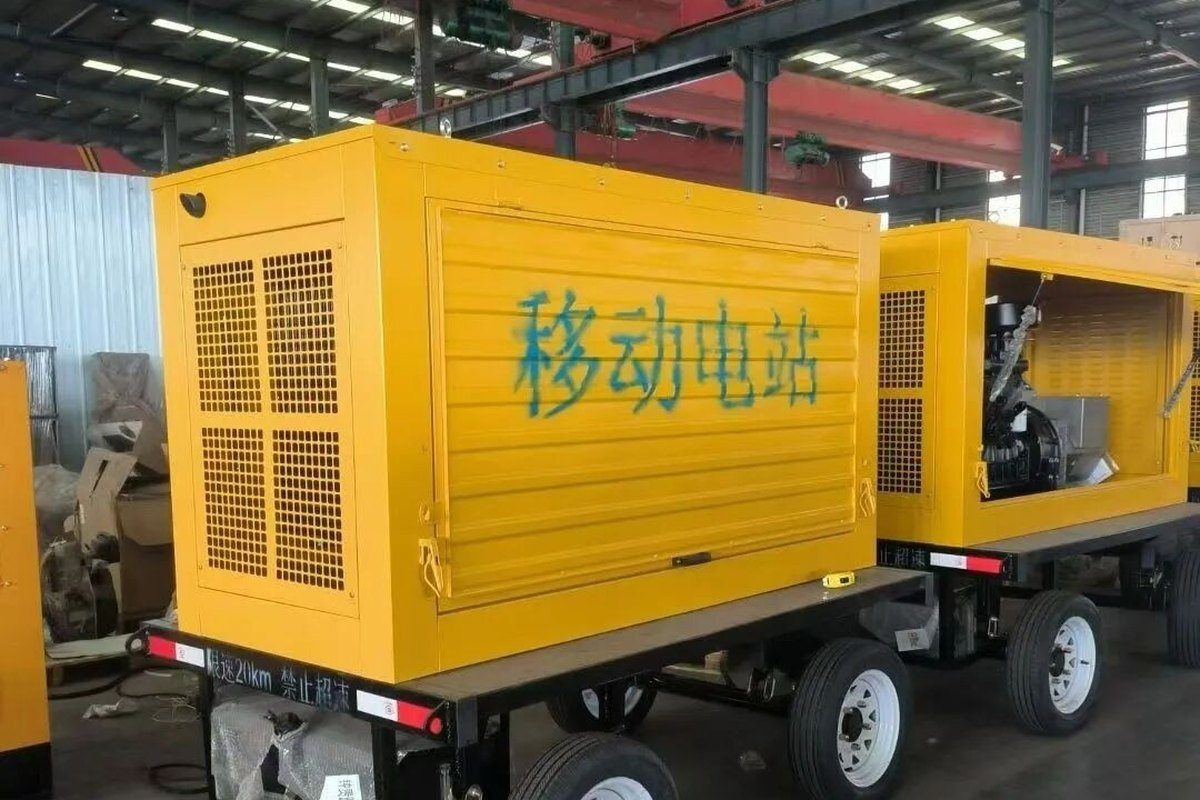
A trailer-mounted station and a power vehicle are both "generators that move" and nothing else about them is the same. A power vehicle is a motor vehicle: chassis, type approval, licence, city access. A trailer-mounted station is a generator bolted to a trailer: not road-registered in most markets, shipped as a generating set, and the cheapest and fastest format we deliver.
Short answer: 20–800 kW of silenced set fixed to a single- or twin-axle flatbed, towed at 25–80 km/h design speed. It is not a motor vehicle: no special-purpose vehicle approval, no CCC, no B2 licence, no truck access restrictions. It exports under HS 8502 without vehicle export licensing — that is the real advantage. The trade is that it cannot drive itself.
Trailer versus power vehicle, item by item
| Trailer-mounted station | Self-propelled power vehicle | |
|---|---|---|
| Motive power | Towed; cannot drive itself | Drives itself, leaves immediately |
| Vehicle type approval / CCC | Not required | Required; without it, no plates |
| Licence and city access | Not applicable | B2 above 4.5 t, daytime bans common |
| Export customs | Generating set, HS 8502 — no vehicle export licence | Vehicle export licence and destination certification |
| Price at equal rating | 25–40% lower (no chassis or cab) | Higher; chassis is 10–15% |
| Lead time | 25–50 days | 50–90 days |
| Response | Needs a towing vehicle — slower to deploy | One driver, straight to site |
| Practical band | 20–800 kW (above that, semi-trailer) | 20–3000 kW |
One line to decide: if it must leave at a moment's notice, buy the vehicle; if it must be cheap, fast and exportable, buy the trailer. Most emergency fleets run both — trailers parked at fixed points, vehicles for cross-region support.
Six details that have to be right
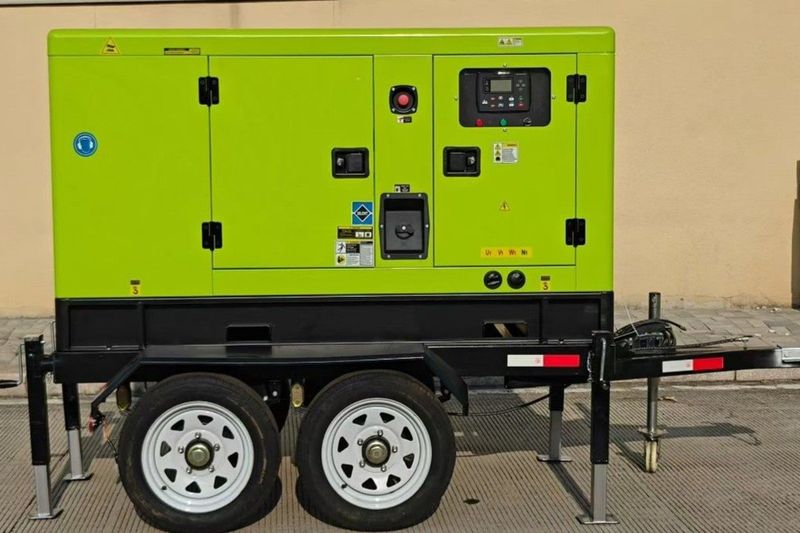
- Axles: single axle to 200 kW, twin axle 200–500 kW, twin heavy or four-wheel 500–800 kW. Above 3 t per axle, go twin — a single axle tows with visible sway.
- Drawbar and jockey wheel: coupling height matched to the usual towing vehicle (typically 450–550 mm), self-locking jockey wheel so one person can hitch. A drawbar that is too short puts the trailer into the tow vehicle's bumper on full lock.
- Braking: overrun (impact) braking above 750 kg, parking brake above 3.5 t. An unbraked trailer on a slope is dangerous, not merely illegal.
- Lighting: tail, indicator, stop, outline marker, side reflectors, warning triangle — and compliant with the destination country's rules.
- Isolation: four rubber mounts between body and deck, not welded down. Welded bodies crack at the seams on rough roads — this is our most common after-sales issue on trailers.
- Lifting points: four corners, marked with the centre of gravity. Needed for craning at both ends of the sea voyage.
One more free detail: give the deck a drainage fall. Water standing under the body rusts through the floor, especially after sea transport and in wet seasons. A slight crown with corner drain holes costs almost nothing.
What a quotation should contain
| Group | Items | Notes |
|---|---|---|
| Standard | Silenced set 75–85 dB(A) at 7 m, base tank for 8 h, control panel, emergency stop, breaker, output box with cam-lock or IEC 60309 outlets, flatbed trailer, four-point isolation, drawbar, jockey wheel, lighting, reflectors, lifting points | Should be in every quotation |
| Options | Cable reel 30 / 50 m, hydraulic or screw outriggers, overrun and parking brakes, upgraded acoustic enclosure, dual voltage 400/480 V, paralleling interface | Priced against the duty |
| Export add-ons | CE marking and technical file, EPA / Tier 4 Final, destination trailer type approval, salt-mist protection, sea-worthy packing, English manual and test report | Depends on the market |
Export: HS code, documents and packing
| Step | Requirement | Common mistake |
|---|---|---|
| HS code | 8502.11 up to 75 kVA, 8502.12 for 75–375 kVA, 8502.13 above 375 kVA | Wrong code changes the rebate and the regulatory conditions |
| Description | "Diesel generating set (trailer-mounted)" | Writing only "trailer" gets it classified as a vehicle |
| Packing | Flat rack or break bulk, moisture barrier over the set, control panel packed separately against shock | Shipped bare, salt mist corrodes panel terminals |
| Lashing | Lash to the trailer's own lifting/tie points, never to the body | Lashing the body tears the isolators |
| Destination approval | EU: O1/O2 trailer type approval; US: DOT lighting rules; Australia: ADR | Assuming "trailers need no approval" — and getting held at port |
To be accurate about a claim we hear often: "trailers need no certification" is true in China and in several emerging markets, not in the EU. O1 (≤750 kg) and O2 (750–3,500 kg) trailers have explicit type-approval requirements covering lighting, braking and coupling. The US has DOT rules on lighting and reflectors. When we export to those markets, that part is handled by a local partner — or we ship the set in a flat rack and the customer fits a locally approved trailer chassis on arrival, which is the simplest route.
Price and lead time
| Configuration | Indicative FOB China | Lead time | Typical duty |
|---|---|---|---|
| 20–50 kW single axle | USD 11,000–21,000 | 25–35 days | Telecom sites, small events, rental |
| 80–150 kW single / twin axle | USD 21,000–35,000 | 30–40 days | Construction, farms, temporary supply |
| 200–300 kW twin axle | USD 35,000–56,000 | 35–45 days | Mining, ports, overseas projects |
| 400–500 kW twin heavy | USD 56,000–83,000 | 40–50 days | Substation support, large sites |
| 500–800 kW twin / four-wheel | USD 83,000–132,000 | 45–60 days | Regional standby, EPC projects |
Cost split: set 65–75%, acoustic enclosure 10–15%, trailer 8–12%, switchgear and reel 5–10%. Saving money on braking or isolation mounts is a false economy — the repair cost exceeds the saving every time.
Export prices FOB / CFR / CIF against a named port. 20–500 kW units usually load one or two per 40HQ or 40FR; above 800 kW expect flat rack or break bulk.
Questions buyers actually ask
Does a trailer-mounted station need vehicle type approval?
No. It is not a motor vehicle: no special-purpose vehicle approval, no CCC, no B2 licence. Inside a plant or on a site it needs no registration; towing on public roads may require a temporary plate or an oversize permit, depending on the jurisdiction.
How large can a trailer-mounted unit be?
In practice up to 800 kW. Above 1,000 kW the towing and braking requirements escalate and a low-bed semi-trailer or multi-box arrangement is the sensible answer.
How is it declared for export?
As a diesel generating set: HS 8502.11 up to 75 kVA, 8502.12 for 75–375 kVA, 8502.13 above 375 kVA. Describe it as "diesel generating set (trailer-mounted)" — not simply "trailer".
What certification does the EU require?
O1 (≤750 kg) and O2 (750–3,500 kg) trailers require type approval covering lighting, braking and coupling. The safe route for a one-off export is to ship the set in a flat rack and let the customer fit a locally approved chassis.
What does a trailer-mounted station cost?
Indicative FOB China: 20–50 kW USD 11,000–21,000; 80–150 kW USD 21,000–35,000; 200–300 kW USD 35,000–56,000; 400–500 kW USD 56,000–83,000; 500–800 kW USD 83,000–132,000.
Trailer or container?
Trailer if it has to move; container if it stays put. A trailer relocates quickly; a container has better protection and cooling and a lower cost per kW once installed. Neither needs vehicle type approval.
Send the rating, destination and shipping method
Tell us the rating, voltage and frequency, destination port, whether CE or EPA is needed, and whether you will tow it or ship it in a container. You get a configuration list, packing proposal and FOB / CIF price.
Related: Mobile power units 20–3000 kW · 20–200 kW pickup & light truck · 200–500 kW truck-mounted · 800–3000 kW medium voltage · Export process and documents · Hospital standby · Data centre · Events · Emergency response