Pickup and light-truck mobile power units: 20–200 kW
This is the busiest band we quote and the one most often specified wrong. Buyers pick a rating first, then discover that a pickup cannot legally carry a 100 kW silenced set — not because nobody builds it, but because the rear axle runs out of payload and the vehicle fails its weight test. Here is the arithmetic: mass, axle load, tank size, cable and type approval.
Short answer: a pickup-mounted unit (4,050 kg GVW) is realistically a 30–80 kW machine. 90–150 kW needs a 4.5 t light truck; 150–200 kW needs a 6–8 t medium truck. The dividing line is not the rating — it is whether set mass + eight hours of fuel + body stays inside the rear axle rating. Most pickup conversions leave only 1.5–1.8 t of legal margin.
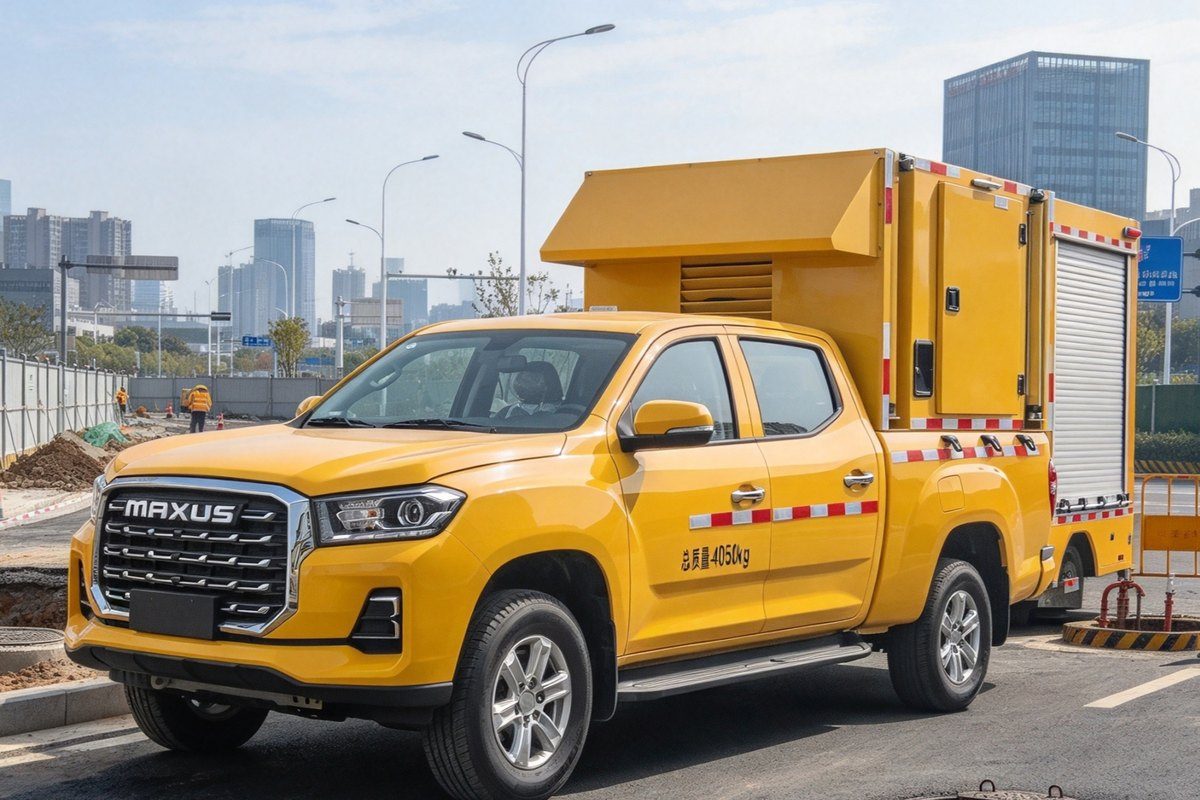
Start with mass, not with kilowatts
Four masses add up, and the total has to stay inside the axle rating — not just the GVW:
| Rating | Silenced set | 8 h of fuel | Body + switchgear | Total | Chassis |
|---|---|---|---|---|---|
| 30 kW | 850–1,000 kg | 60 L / 50 kg | 350 kg | ~1.45 t | Pickup, comfortable |
| 50 kW | 1,100–1,300 kg | 90 L / 76 kg | 380 kg | ~1.78 t | Pickup, near limit |
| 80 kW | 1,500–1,750 kg | 140 L / 118 kg | 420 kg | ~2.3 t | Pickup borderline — use a light truck |
| 100 kW | 1,900–2,200 kg | 170 L / 143 kg | 450 kg | ~2.8 t | 4.5 t light truck |
| 150 kW | 2,600–3,000 kg | 250 L / 210 kg | 500 kg | ~3.7 t | Light truck limit / 6 t medium |
| 200 kW | 3,300–3,800 kg | 330 L / 277 kg | 550 kg | ~4.6 t | 6–8 t medium truck |
Fuel is estimated at 200–210 g/kWh and 0.84 kg/L at full load. Halving the tank to four hours is the only legal way to save weight in this band — and it is often enough, because most units refuel on site anyway.
Mass distribution matters more than total mass. Sets sit at the rear, and a pickup rear axle is typically rated 1.8–2.0 t. Moving the body 20 cm rearward can push the axle over its rating even when the GVW looks fine — and axle loads are weighed separately at inspection.
Three carrier formats
| Format | Band | Strength | Limit | Indicative FOB |
|---|---|---|---|---|
| Cart-mounted | ≤30 kW | No registration, no driver, one person moves it, fits through a plant-room door | No brakes, no road speed, useless in mud | USD 3,000–9,000 |
| Pickup-mounted | 30–80 kW | Highway legal, city access, parks in a car bay, fastest response | Low body, radiator must go side or rear, short air path | USD 25,000–36,000 |
| Light / medium truck | 90–200 kW | Payload for twin doors, hydraulic outriggers and a 100 m reel | Over 4.5 t GVW it is a yellow-plate truck: B2 licence, city daytime bans | USD 36,000–76,000 |
Body cooling: where most conversions fail
Plant-room habits do not transfer. The body is small, intake and exhaust are close together, and hot air that leaves the exhaust gets pulled straight back in.
- Free intake area at least 1.5× the radiator face area — "free" meaning after louvres, mesh and silencer baffles are deducted.
- Exhaust area at least 1.2× the radiator face, then add another 20% for the pressure drop of the silencer inserts.
- Never put intake and exhaust on the same side at the same height — recirculation adds 8–12 °C inside the body in our measurements.
- Re-rate the fan. Standard fans are selected for plant-room resistance; a body, baffles and a bend can double the system resistance and cut airflow by a third. The classic result is a high-temperature alarm two hours into a full load.
- Acceptance test: 40 °C ambient, full load, four hours continuous, no derate and no trip. Put that sentence in the technical agreement or you will argue about it at handover.
Pickups add one hard constraint: internal body height is usually only 1.4–1.5 m, so roof discharge is impossible and the radiator has to go to the side. Side discharge needs a deflector, otherwise the door skin next to the outlet becomes too hot to touch.
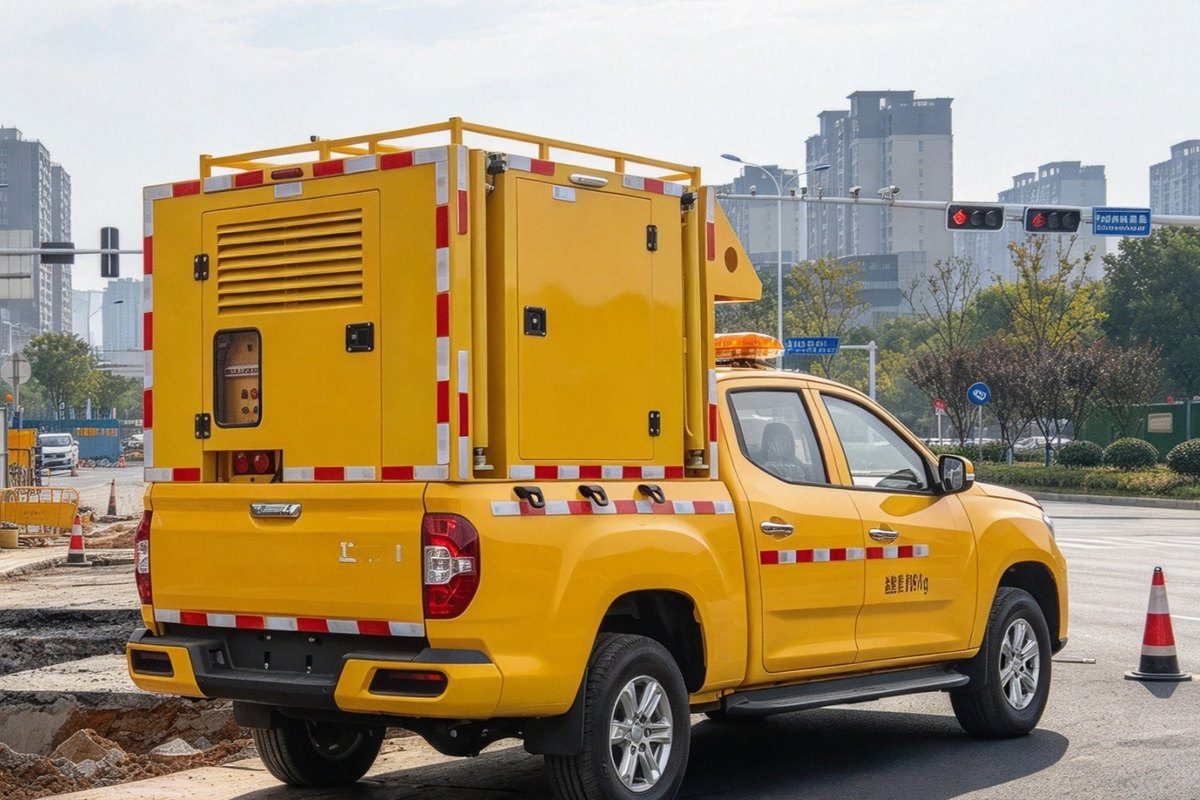
Roller shutter at the rear for loading the set, side door for daily checks — oil, coolant, control panel — without opening the whole body.
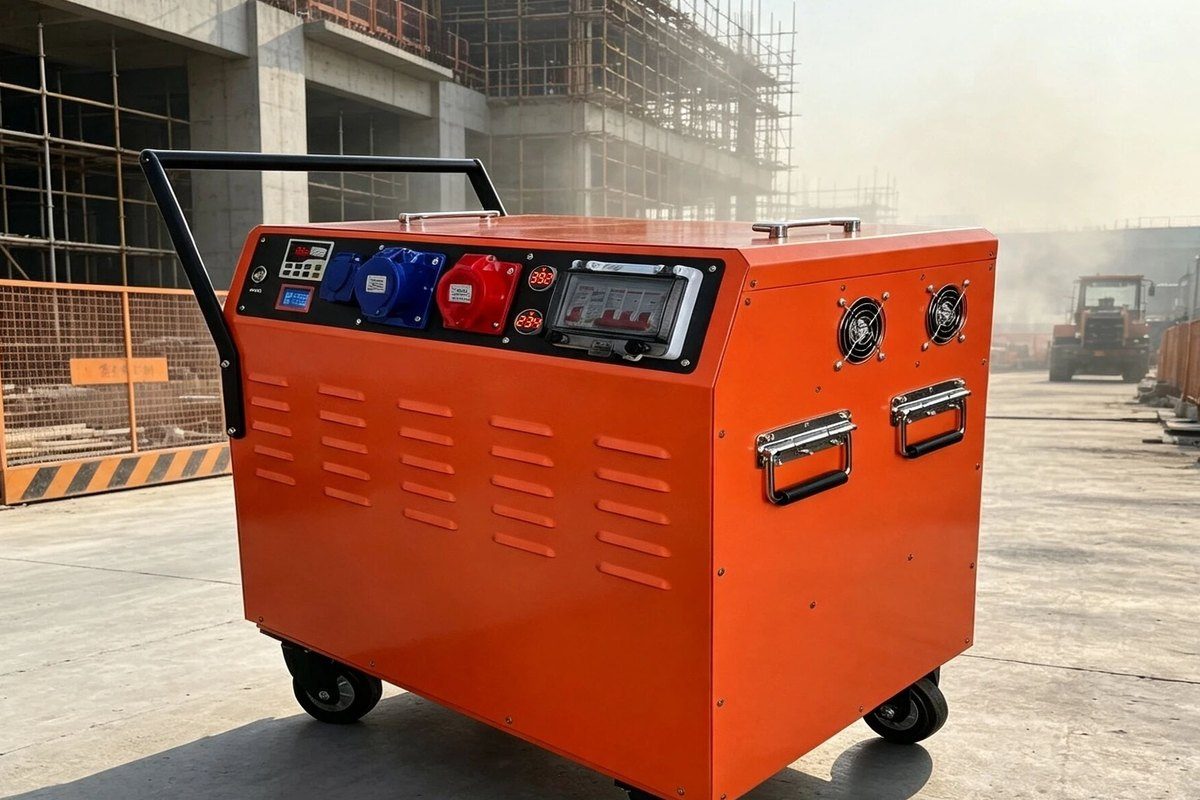
Below 30 kW, a cart-mounted unit beats a vehicle: no registration, no driver, industrial sockets and RCD built into the panel.
Cable size and reel length
| Rating | Full-load current (400 V, pf 0.8) | Copper cross-section | Volt drop at 50 m | Typical reel |
|---|---|---|---|---|
| 50 kW | ~90 A | 35 mm² | ~0.5% | 30 m |
| 80 kW | ~144 A | 70 mm² | ~0.7% | 30–50 m |
| 100 kW | ~180 A | 95 mm² | ~0.8% | 50 m |
| 150 kW | ~271 A | 150 mm² | ~0.9% | 50 m |
| 200 kW | ~361 A | 185 mm² or 2×95 mm² | ~0.9% | 50–100 m |
Two practical points. Cable on a reel is coiled, so it cools worse than free air — derate the tabulated current by 0.85 and take the next size up. And calculate volt drop at full load with 3% margin, because motor starting and inverter loads draw far more than the continuous figure.
Longer is not better: 100 m of 185 mm² copper weighs about 340 kg, plus a 120 kg reel. That is the entire payload of a pickup. If the site genuinely needs 100 m, that is the signal to move up to a light or medium truck.
Type approval, registration and export
A converted pickup or light truck is an N1 / N2 special-purpose vehicle. It needs a converter licence, a product type approval and CCC certification before it can be registered. Without an approval the vehicle is an illegal modification — no plates, no annual inspection, and an insurer may decline a claim.
Genset Butler does not hold a special-purpose vehicle licence. So the boundary is stated plainly: we supply the set, on-board switchgear, control panel, cable reel, outriggers and isolation mounts; the body, the conversion and the type approval are completed by a licensed partner. Many customers prefer to buy the set-and-package from us and integrate it in their own workshop — that is our most common arrangement.
If the unit works inside a plant, on a mine site, or is going overseas, a trailer-mounted unit avoids all of this: a towed unit is not registered as a vehicle in most markets, and it ships under HS 8502 as a generating set. See trailer-mounted mobile power stations.
Price and lead time
| Configuration | Indicative FOB China | Lead time | Typical duty |
|---|---|---|---|
| 30–50 kW pickup-mounted | USD 25,000–36,000 | 30–45 days | Municipal repair, telecom sites |
| 80–100 kW pickup / light truck | USD 36,000–53,000 | 40–55 days | Distribution maintenance, events |
| 150–200 kW light / medium truck | USD 53,000–76,000 | 50–70 days | Construction, hospital and data-centre standby |
Cost split: set 55–65%, body and conversion 15–20%, switchgear and reel 12–18%, chassis 10–15%. That is why two quotes for the same rating can differ by USD 15,000 — engine brand, acoustic level, reel length and chassis brand. Compare those four before comparing totals.
Prices are indicative FOB China references, excluding freight, duties, taxes and registration. Export quotes are FOB / CFR / CIF against a named port.
Questions buyers actually ask
Can a pickup carry a 100 kW set?
Physically it fits; legally it does not. A 100 kW silenced set is around two tonnes, and with body and fuel the rear axle is overloaded, so the vehicle cannot be registered. We normally move 90 kW and above to a 4.5 t light truck.
How do I choose the chassis for 20–200 kW?
30–80 kW: 4,050 kg GVW pickup. 90–150 kW: 4.5 t light truck. 150–200 kW: 6–8 t medium truck. The test is that set mass plus eight hours of fuel plus body stays inside the rear axle rating.
Do I need hydraulic outriggers?
Below 100 kW, screw jacks are enough — cheaper and fewer failures. Above 150 kW use four-point hydraulic outriggers with a spread of about 1.2× body width, and always put plates under the feet on soft ground.
How is body cooling calculated?
Free intake area ≥1.5× radiator face, exhaust ≥1.2×, plus 20% for silencer inserts. Intake and exhaust must not share a side at the same height. Accept at 40 °C ambient, full load, four hours, no derate.
What does a mobile power unit cost?
30–50 kW pickup-mounted USD 25,000–36,000; 80–100 kW USD 36,000–53,000; 150–200 kW USD 53,000–76,000, FOB China. The set is 55–65% of the total.
Who is responsible for vehicle type approval?
A pickup or light-truck conversion is an N1/N2 special-purpose vehicle requiring a converter licence and product approval. We supply the set, on-board electrical package, panel, reel and outriggers; the licensed partner completes the body and the approval.
Send the load list, and we will size the chassis
Tell us the rating, duty, whether the unit must be road-registered, and the destination market. You get a chassis recommendation, set model, cooling scheme and a price range — plus a clear statement of which part the body builder does.
Related: Mobile power units 20–3000 kW · 200–500 kW truck-mounted · 800–3000 kW medium voltage · Trailer-mounted stations · Price guide · Hospital standby · Data centre · Events · Emergency response