Event and stadium power: sizing a mobile generator that will not black out
Powering a concert is not powering a site. A site loses schedule when the power fails; a show loses the audience, the broadcast and the promoter's reputation. So this page starts with the three things that actually decide the outcome — how unfriendly the load is, how fast the transfer is, and whether the noise gets you shut down.
Short answer: a 5,000-capacity outdoor show with lighting, audio and LED walls lands at 350–500 kW: two 250 kW units in parallel or one 500 kW, with a UPS on the critical loads (mixing desk, radio mics, timing and scoring, broadcast). Do not add up nameplate wattages: stage lighting runs at 60–70% simultaneity, while triac dimmers pull the power factor below 0.7 — one factor up, one down, and you still end at about 0.8.
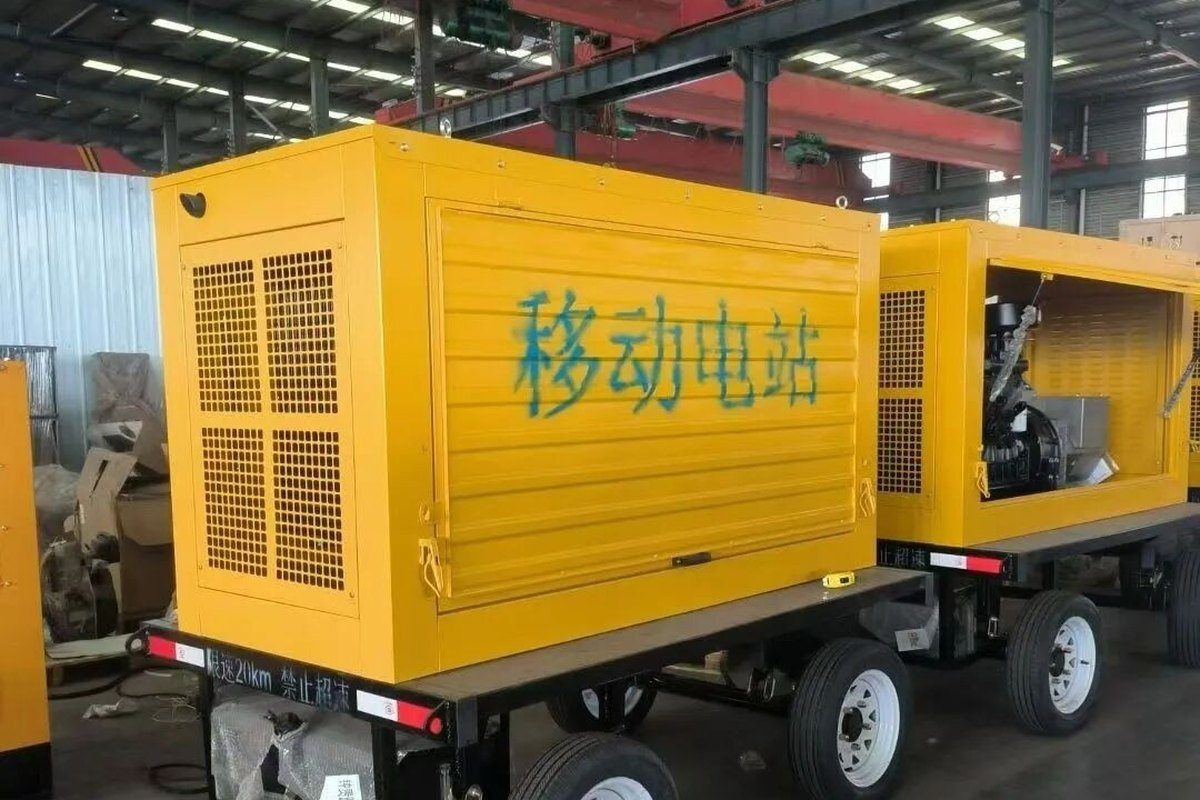
Get the load right: three factors that move the price
| Venue | Audience | Lighting | Audio + LED | Other | Design load | Configuration |
|---|---|---|---|---|---|---|
| Club / mall atrium | 500 | 60–100 kW | 30–50 kW | 20 kW | 120–180 kW | 1 × 200 kW |
| Mid-size festival | 5,000 | 200–300 kW | 80–120 kW | 50 kW | 350–500 kW | 2 × 250 kW or 1 × 500 kW |
| Stadium / arena | 30,000 | 500–800 kW | 200–300 kW | 100 kW | 800–1,200 kW | 2 × 630 kW + standby |
| Broadcast grade | — | +100–150 kW | +80 kW | — | reserve 200 kW | Dedicated bus + UPS |
Three factors: simultaneity 0.6–0.7, power factor 0.7 for triac dimming, margin 1.15. Multiplied out they differ from the nameplate sum by up to 40% — which is why three quotes for one show can differ by USD 12,000.
Three loads that are not grid-friendly
- Triac dimming. Phase-angle control produces strong third and fifth harmonics at 0.6–0.7 PF. Derate the set to 0.8, and remember the neutral current can exceed the phase current — in a TN-S system the neutral must not be smaller than the phase conductor.
- LED walls and switch-mode supplies. Capacitor inrush at power-up reaches 2–3× rated current, worse on large walls. Sequence the walls on, add inrush limiting, or put them behind the UPS.
- Amplifiers. Music has a 12–18 dB crest factor, so transient current far exceeds average. Size on average power and the loud passages will show voltage sag and dimming lights.
Dual feed and transfer: two seconds of black is enough to lose the crowd
The standard is two feeds plus UPS, not "one big reliable vehicle". Even a good set has fuel, coolant and controller failure modes, and a show has no "give us five minutes" option.
- Two independent buses with a mechanical changeover at the final distribution board. Never "join" two sources inside a board — that is a short circuit.
- UPS the critical loads: mixing desk, radio-mic receivers, timing and scoring, broadcast switcher. They draw 5–20 kW and their loss is the incident.
- Transfer targets: lighting ≤0.5 s (dual supply or UPS), audio ≤10 ms (UPS only), LED walls 1–2 s acceptable.
- Never parallel a generator with mains without synchronising gear and utility permission. Private paralleling at event sites is a recurring cause of accidents.
Noise and position: agree this before the load list
Night limits at venue boundaries are typically 55 dB(A), stricter near housing, while a canopied set is 65–70 dB(A) at 7 m. The vehicle cannot sit next to the audience. Three measures, usually combined:
- Distance — 6 dB per doubling; moving from 10 m to 40 m buys about 12 dB.
- Barrier — a 2 m absorptive panel between vehicle and audience gives 8–12 dB in practice.
- Building shadow — behind a grandstand or outside a venue wall beats any barrier.
Distance costs cable. At 400 V a 200 kW set draws about 360 A; on 185 mm² copper, 100 m drops roughly 1.8% and 300 m passes 5% — lights flicker and audio hums. Above 150 m, step up with a local transformer or split the generation close to the loads, which is another reason trailers win at events.
Load-in, load-out and fuel
| Item | Requirement |
|---|---|
| Load-in window | 4–6 h before doors; build and rehearsal must be powered, not just the show |
| Vehicle position | Hard standing, ≥10 t bearing, ≥12 m turning circle, clear of fire lanes and evacuation routes |
| Fuel | Rehearsal + show + load-out: plan 10–12 h at full load, not the show duration |
| Spares | Fuses, contactor, controller, coolant sensor, one spare 5 m cable |
| Load-out | Off site within 2 h of the show, avoiding audience flows |
Acceptance: the rehearsal is the test
Do not accept an event package on a resistive load bank — accept it on the rehearsal. Push lighting to the programme peak, walls to full white, audio to maximum SPL, and record three numbers: current unbalance (<15%), voltage dip (<10%) and frequency deviation (<±0.5 Hz). With those recorded in rehearsal, the show has a baseline.
One more step people skip: do a real transfer. Open the mains during rehearsal and let the changeover happen for real. Problems that only appear then — a click through the audio, a wall that reboots, a console that loses its show file — are exactly the ones you cannot fix at showtime.
Questions promoters ask
What size for a 5,000-capacity show?
350–500 kW design load: two 250 kW in parallel or one 500 kW. Add 150–200 kW on a separate feed if there is broadcast. The figure assumes a conventional lighting rig — check the lighting plot and wall area for the real number.
Can the generator be paralleled with mains?
Technically yes with synchronising gear, protection settings and utility approval, which event sites rarely have. The normal practice is an interlocked changeover, not parallel operation. "Parallel gives seamless transfer" simply moves the risk onto the equipment and the operator.
Why do the lights flicker?
Three candidates: excessive cable length and volt drop (check voltage at the far end), undersized set causing frequency swing (check the frequency meter), or interaction between triac dimmers and the excitation system (PMG excitation or filtering). Measure voltage and frequency before changing hardware.
Does temporary event power need earthing?
Yes, more strictly than a construction site. Bond stage steelwork, trusses and audio racks; match the generator neutral treatment to the site system; give audio its own signal earth to avoid ground loops. Get it wrong and you hear hum, or the mic shocks someone.
Will the noise be reported?
Near housing, probably. Move the vehicle at least 50 m from the boundary, add a barrier and keep running hours inside the permitted window. Agree the limit and the complaint procedure with the venue beforehand.
Rent or buy?
Three or more shows a year or a permanent venue justifies purchase; one or two a year does not. If you buy, specify a low-noise body and quick connectors — a standard site unit brought to a stage will fail on both.
Prefer paper? Download this brief as a one-page PDF — A4, English and Chinese, free, no form.